
d-Matrix Joins NVIDIA’s Platform. The AI Chip Race Is Becoming a Systems Race
The planned Raptor integration expands the choice of AI accelerators inside NVIDIA’s infrastructure, but its real value will depend on the cost and reliability of the complete service.
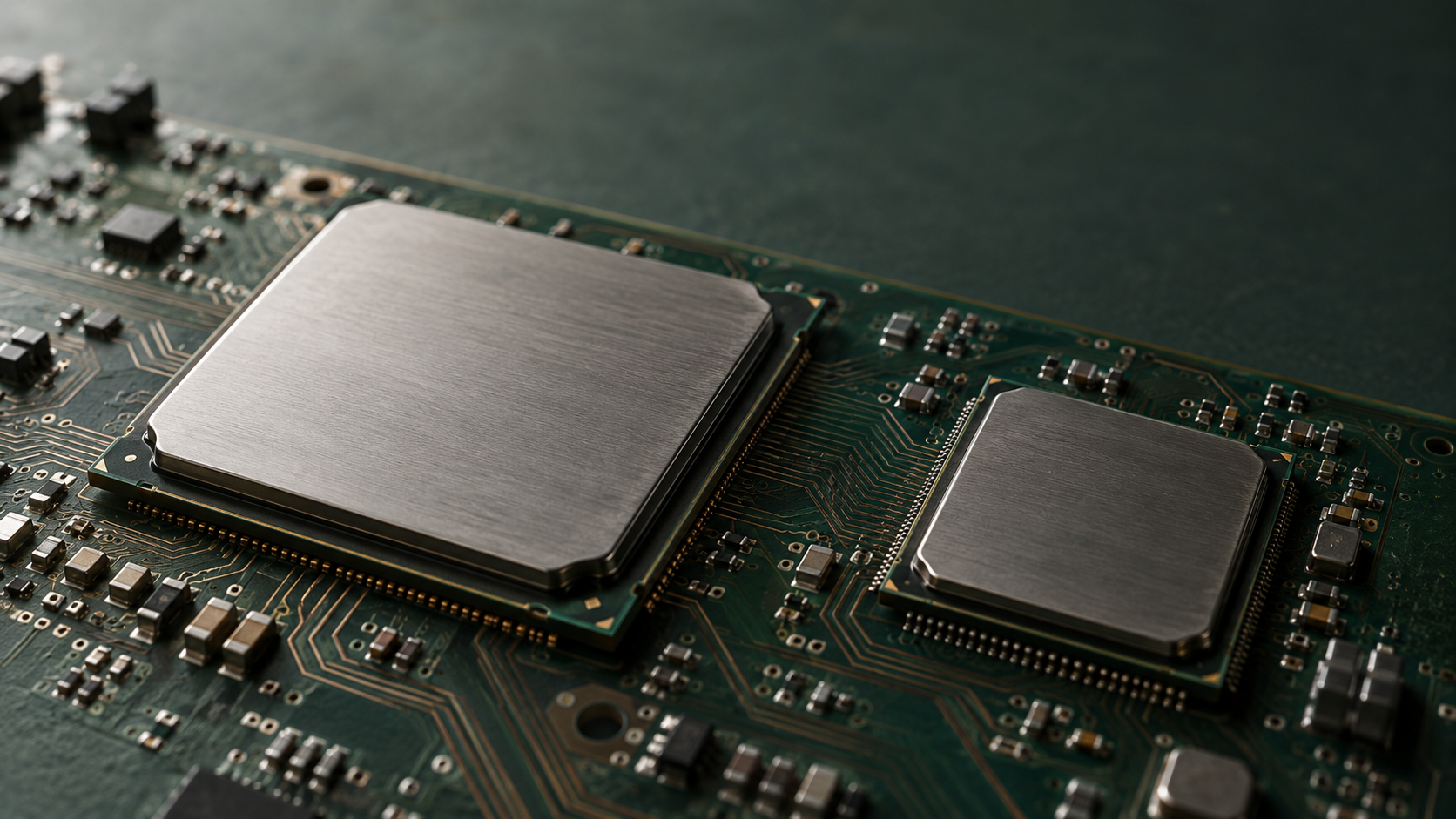
d-Matrix’s planned NVIDIA integration highlights the growing role of specialised processors in AI inference infrastructure.
d-Matrix’s decision to join NVIDIA’s NVLink Fusion ecosystem complicates the familiar story of an AI chip startup taking on the incumbent. Announced on 10 September 2026, the collaboration is intended to put d-Matrix’s forthcoming Raptor inference processors into NVIDIA’s MGX rack architecture. The significance is broader than another component partnership: a company can offer an alternative processor while choosing the larger supplier’s infrastructure as its route to customers.
That is a consequential distinction for businesses trying to understand where AI competition is heading. More choice of silicon does not necessarily mean more independence from the platform surrounding it. Equally, common infrastructure could make a specialist processor easier to deploy. The useful question is how much of the complete service improves when a different chip is introduced, and what new dependencies accompany that improvement.
What d-Matrix and NVIDIA have actually announced
The d-Matrix announcement describes a multi-year collaboration, beginning with a Raptor-based rack aimed at latency-sensitive services such as coding assistants and voice agents. Initial availability is expected in the fourth quarter of 2027, with Raptor’s tape-out planned before the end of 2026. Tape-out is the point at which a chip’s design is finalised for fabrication; it is not the same as production systems being available to buy.
NVIDIA’s account of the partnership sets out the surrounding platform: NVLink for communication within a tightly connected group of processors, Spectrum-X networking between systems, and MGX for rack integration. Planned components include Vera CPUs, ConnectX-9 network adapters and BlueField-4 data-processing units. The promise is a more established deployment path, although that remains a vendor expectation rather than an independently demonstrated result for the forthcoming Raptor system.
Why running an AI model is not a single hardware problem
Inference means using a trained model to produce an output, rather than training the model itself. In a language-model service, the work includes processing the user’s input and then generating the response. These stages are usually called prefill and decode, terms that sit within the wider vocabulary covered in Nuvastra’s AI glossary. They can place different demands on the same machine, which creates an opportunity to divide the work.
As NVIDIA’s explanation of disaggregated serving describes, prefill is typically compute-heavy, while decode depends heavily on memory bandwidth. Separating them allows the stages to be optimised differently, but requires software to coordinate requests and transfer the intermediate information known as the key-value cache. Faster individual components are useful only if the handover between them does not consume the benefit.
For a reader using a coding assistant, that difference appears as two experiences: the wait before a response begins and the pace at which the answer arrives. A service can improve one while disappointing on the other. Judging an AI system by a single throughput figure therefore leaves out part of what its customers are buying, particularly when several people use it at once.
The memory argument behind Raptor
Raptor extends d-Matrix’s memory-centric approach. In its earlier explanation of 3D DRAM, the company describes adding a memory layer above the compute layer to increase capacity while retaining low-latency access. Its stated motivation is that scaling fast on-chip SRAM alone becomes insufficient as models and their memory requirements grow. Those architectural intentions should not be confused with a verified performance advantage for a complete, commercially available Raptor rack.
The broader engineering point is that storing more information and moving it quickly are separate problems. A model can fit into a system’s memory yet still spend too much time waiting for information to reach the processor. Changing memory placement is one response; improving the connections between processors is another. The partnership combines those approaches, but neither removes the need to test the actual model, traffic pattern and software configuration.
More accelerator choice, the same infrastructure supplier
NVLink Fusion is designed to bring custom processors into NVIDIA’s wider infrastructure. Its appeal is partly operational: compatible rack layouts, power delivery, cooling and supply chains could reduce the work needed to introduce another kind of accelerator. That makes the infrastructure decision distinct from the processor decision. A customer might diversify the hardware doing the calculations without replacing the systems on which that hardware depends.
Our reading is that this gives NVIDIA a way to participate in an increasingly varied chip market without having to manufacture every specialist processor. For d-Matrix, it offers a potential route around the burden of establishing every surrounding component independently. These incentives can coexist; describing the arrangement simply as either a victory over NVIDIA or a surrender to it would miss why both parties might want it.
The same distinction matters when reading AI model comparisons. A model’s capability, the hardware serving it and the operational service wrapped around it are different layers of the proposition. An improvement at one layer cannot automatically establish lower costs or better results across the whole application.
Where the economics still need proving
Disaggregation is not universally the cheapest design. In its SageMaker HyperPod implementation guide, AWS explains why separating prefill and decode can help long-context, concurrent workloads, while a simpler combined deployment can remain appropriate for low-concurrency or short-prompt traffic. Moving the cache has a fixed cost, so splitting work that was already running efficiently can introduce overhead without enough compensating benefit.
This caution also appears in NVIDIA researchers’ study of inference disaggregation. The work, published as a preprint in June 2025, identifies workload mix, matching the rates of different processing stages and flexible scaling as important determinants of performance. It is useful context for the architecture, not a benchmark of Raptor, and should not be presented as independent validation of this partnership’s commercial claims.
A meaningful evaluation would hold the model, output quality, input lengths and concurrency constant, then measure response time, completed work, power and the cost of the entire system. It should also include failures and retries. As Nuvastra’s discussion of deterministic execution and probabilistic AI explores, useful automation depends on what the overall workflow reliably does. Cheap or rapid token generation is not a substitute for a correct completed task.
The next milestone is a working service
The announcement establishes a direction of travel, not a finished economic result. Customers now have a specific integration roadmap to examine, and the eventual evaluation should ask whether specialist silicon earns its place after the networking, software and operational costs are counted. The most interesting competitive shift may be that AI infrastructure becomes more varied inside the rack while remaining concentrated around the platform that makes those components work together. Whether that combination delivers better value will be settled by deployed systems, not the partnership headline.
Questions about d-Matrix, Raptor and NVLink Fusion
Does this mean NVIDIA has acquired d-Matrix?
No acquisition is announced in the companies’ statements. They describe a collaboration to integrate d-Matrix processors with NVIDIA infrastructure, which is different from a change of ownership.
Can customers buy the integrated Raptor racks now?
The stated target is initial availability in the fourth quarter of 2027. As of 11 September 2026, it is a roadmap announcement, so the proposed integration should not be treated as a shipping product.
Will Raptor replace GPUs for every AI workload?
That is not what the announced architecture proposes. NVIDIA describes specialist d-Matrix systems working alongside GPU-based systems, with different hardware assigned to suitable parts of the workload.
Is NVLink Fusion itself an AI model?
No. It is infrastructure technology for connecting custom processors with NVIDIA’s platform; it does not supply the trained model’s knowledge or determine whether its answers are correct.
Is splitting prefill and decode always faster?
No universal gain follows from splitting them. The outcome depends on traffic, memory transfers, scheduling and utilisation, so a simpler configuration can remain preferable for some workloads.
What evidence would make the performance claims convincing?
Tests should compare complete systems under matched workloads and quality requirements, with clear latency, throughput, power and cost measurements. Results from a different product, simulation or hand-picked configuration need to be labelled accordingly.