
China’s ‘Robot Olympics’: Inside the 2026 World Humanoid Robot Games
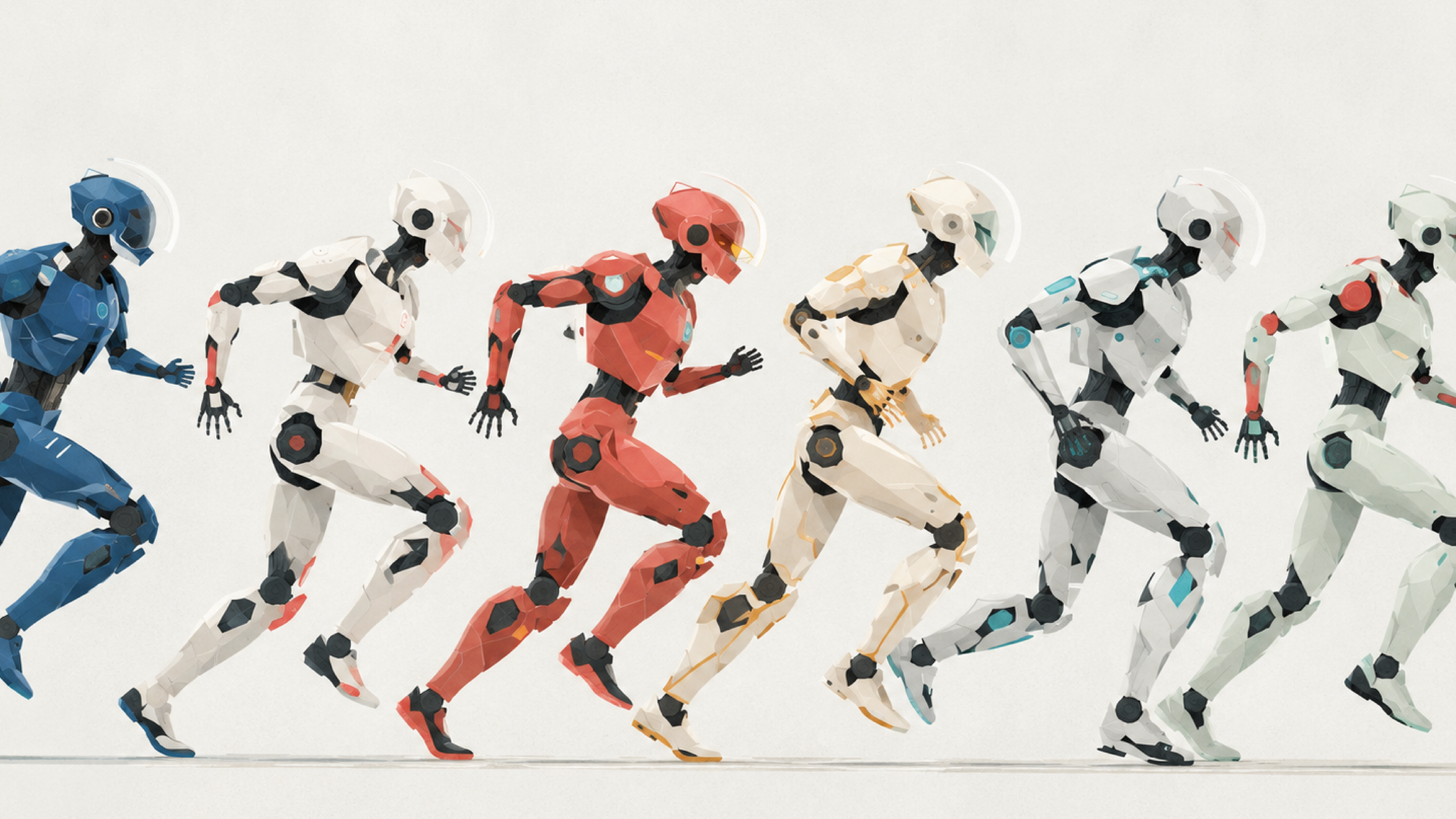
At Beijing’s World Humanoid Robot Games, more than 2,000 robots are running, fighting, playing football and attempting everyday work. Behind the spectacle is a much bigger test of embodied AI.
Updated 24 August 2026
A humanoid robot stood at the start of a blue running track inside Beijing’s National Speed Skating Oval on Saturday and covered 100 metres in 9.39 seconds. The number attracted attention for an obvious reason. Usain Bolt’s world record for the human 100 metres is 9.58 seconds.
The machine, Tiangong Ultra, developed by the Beijing Humanoid Robot Innovation Center, was not alone. Another Chinese humanoid completed the same distance in 9.47 seconds. The following day, Tiangong Ultra ran 400 metres in 38.15 seconds, compared with Wayde van Niekerk’s human world record of 43.03 seconds. There was, however, one conspicuous difference between the robots and elite human athletes: stopping. After reaching the end of the sprint, machines have repeatedly needed the thick cushioning positioned beyond the finish line to absorb their momentum.
The comparisons make irresistible headlines, but they can also obscure what is happening in Beijing. Tiangong Ultra has not officially broken Bolt’s athletics world record, because a humanoid robot competing under different technical rules is not a human athlete competing under World Athletics regulations. What it has done is complete the same distance in less time. More importantly, running may not even be the most consequential test taking place.
Across the same competition, robots are being asked to recognise objects, plug in cables, operate in warehouses, serve customers, complete factory tasks and recover when their first attempt goes wrong. More than 40 per cent of the tests at this year’s Games require full autonomy, according to technology partner Huawei. Those considerably less theatrical exercises may tell us far more about the future of artificial intelligence than a nine-second sprint.
The event is officially called the 2nd World Humanoid Robot Games. “Robot Olympics” has become the popular international shorthand, while searches for terms such as “China AI Olympics” generally refer to the same event. Between 22 and 26 August 2026, 2,056 robots entered by 666 teams are competing across 51 events and 1,301 competition sessions at Beijing’s “Ice Ribbon”, the speed-skating arena built for the 2022 Winter Olympics. Sixteen countries are represented, although China accounts for the overwhelming majority of participants.
Behind the races, football and martial arts is an experiment in something the AI industry increasingly calls embodied intelligence: whether artificial intelligence can leave the relatively controlled world of screens and software and become capable of perceiving, reasoning and acting reliably in the physical world.
World Humanoid Robot Games 2026: key facts
| Official name | 2nd World Humanoid Robot Games |
|---|---|
| Popular nickname | Robot Olympics |
| Dates | 22–26 August 2026 |
| Location | National Speed Skating Oval, Beijing, China |
| Robots registered | 2,056 |
| Teams | 666 |
| Countries represented | 16 |
| Events | 51 |
| Competition sessions | 1,301 |
| Competitive events | 30 |
| Scenario-based events | 21 |
| First edition | 2025 |
The scale has increased remarkably quickly. Beijing says the inaugural Games in 2025 involved 280 teams, 26 events and 487 competition sessions. One year later, the number of teams has more than doubled and the programme has almost doubled in size.
What are the World Humanoid Robot Games?
The World Humanoid Robot Games are an annual competition in Beijing designed to test humanoid robots across both sporting and real-world tasks. The first Games took place in 2025, while the substantially expanded second edition is running from 22 to 26 August 2026.
Calling them the Robot Olympics makes intuitive sense. There are races, football matches, martial arts, dancesport, strength challenges and other competitions designed to produce clear winners. Yet the analogy only goes so far. The objective is not simply to discover which machine can run fastest or jump highest. The competitions create controlled ways of comparing the rapidly evolving hardware and software required to make a humanoid robot move through the world.
China has also changed what it wants the Games to measure. Beijing’s official description of the 2026 event divides its 51 events between 30 competitive contests and 21 scenario-based tasks. The latter move robots away from specially constructed demonstration arenas and into environments intended to resemble factories, hotels, homes and other working settings.
That change matters because robotics demonstrations can be deceptive. A machine may perform an extraordinary pre-rehearsed movement in a carefully prepared environment yet become unreliable when an object has moved several centimetres, the lighting has changed or a person unexpectedly gets in its way.
The 2026 Games are increasingly designed to expose that gap.
What do robots actually compete in?
The sporting programme is deliberately broad. Robots run races, compete in football, perform martial arts, demonstrate strength and take part in dance and other physical contests. Table tennis and tennis-style competitions bring another difficulty because machines must perceive the trajectory of a fast-moving object before positioning their bodies accurately enough to respond.
Each sport places pressure on a different part of the robotics stack. Sprinting tests locomotion, balance and motor control. Football adds object recognition, navigation, coordination and decision-making. Combat requires rapid reactions while maintaining stability after physical contact. Dancing may look like entertainment, but synchronised movement can expose weaknesses in timing, positioning and whole-body control.
The scenario events are more revealing. Beijing has designed tests around activities including housekeeping, firefighting and retail work, with tasks such as folding clothing, preparing food and performing precise operations. Reuters reports that the broader programme includes cable connection, warehouse operations, electric-vehicle charging, restaurant service and industrial assembly.
A cable provides a useful example. A human can look at a connector and socket, estimate their relative position, move a hand towards them, adjust the angle, feel resistance and make small corrections almost without conscious thought. A robot has to recreate that chain through cameras or other sensors, perception software, spatial estimation, motion planning, actuators and feedback.
The sporting event may be decided by hundredths of a second. In practical robotics, successfully inserting a plug could be the more important result.
Are the robots autonomous?
Some are. Others are not, and that distinction is essential to understanding the World Humanoid Robot Games.
A humanoid can be teleoperated, meaning a person controls its movements remotely. It can follow a pre-programmed sequence, where engineers have determined much of what it will do before an event. Or it can operate autonomously, using its sensors and software to perceive the situation, make decisions and control its movements without a human continuously directing it.
The 2026 Games have pushed further towards the third category. Beijing made the 100-metre race a fully autonomous event and said scenario competitions were being redesigned to encourage autonomous positioning, recognition and operation. Huawei told Reuters that more than 40 per cent of this year’s tests require full autonomy.
That does not mean every machine seen at the Games is an independently thinking robot. Levels of autonomy vary between competitions, demonstrations and platforms, and the word “AI” is often attached too casually to hardware that may rely heavily on human control.
The distinction is important because physical capability and autonomous intelligence are different achievements. Building a robot capable of moving its legs quickly is difficult. Building one capable of deciding where to go, recognising what is happening, choosing an appropriate action and recovering when something unexpected happens is another problem altogether.
Did a robot really beat Usain Bolt?
A humanoid robot has completed 100 metres in less time than Usain Bolt’s 9.58-second human world record, but it did not formally break the athletics world record.
Tiangong Ultra completed a preliminary 100-metre heat at the World Humanoid Robot Games in 9.39 seconds on 22 August. A second machine completed the distance in 9.47 seconds. The robot time is therefore 0.19 seconds below Bolt’s record set at the 2009 World Championships in Berlin.
The wording matters. Human athletics records are produced under rules governing human competitors, starting procedures, track conditions, equipment, wind assistance and other variables. A humanoid robot is a machine with different mechanics, proportions, power systems and competition rules.
The comparison is nevertheless a useful indication of how quickly robotic locomotion is improving. Last year’s machines were dramatically slower. By 2026, robots have reached a point where their raw movement speed can exceed celebrated human benchmarks.
Tiangong Ultra reinforced that progress on 23 August when it won the large-robot 400-metre final in 38.15 seconds. That is 4.88 seconds faster than Wayde van Niekerk’s 43.03-second human world record, although again it should be understood as a timing comparison rather than the replacement of an athletics record.
The 100-metre competition is also not finished. As of 24 August, the Games remain underway and the final is scheduled for 26 August, meaning the fastest published competition time could still change.
The hardest events may be the least spectacular
Humanoid robotics has reached an unusual stage where machines can perform movements that appear superhuman while remaining poor at activities humans regard as mundane.
At the World Robot Conference held in Beijing in the same week as the Games, a robot attempting to fold a shirt failed to complete the apparently simple task. Elsewhere, robots performed backflips, boxed one another and played table tennis.
The contradiction is only surprising if intelligence is treated as one measurable quantity.
Running fast is a difficult robotics problem, but it is relatively constrained. The route is known. The surface is predictable. The objective is unambiguous. Engineers can optimise the robot's mechanical structure and control systems specifically for speed and balance.
Folding a shirt introduces deformable material that changes shape whenever it is touched. The robot needs to identify corners and edges, judge where the fabric will move, regulate the force applied by its fingers, track what happened after each movement and adjust when the result differs from its expectation.
The same problem appears in countless ordinary activities. Picking a particular product from a cluttered shelf, loading a dishwasher, plugging a connector into an unfamiliar machine or preparing food requires perception, spatial reasoning, manipulation, feedback and adaptation to interact continuously.
These are exactly the capabilities a general-purpose robot needs if it is going to become economically useful outside a controlled laboratory.
What is embodied AI?
Embodied AI is artificial intelligence designed to perceive, reason about and act within the physical world through a machine such as a robot.
Most of the AI boom of the past several years has been experienced through screens. Large language models manipulate language. Image models generate pixels. AI agents can browse software, call digital tools and move information between computer systems. Even highly capable multimodal models normally observe the physical world indirectly through images, video or sensor data.
Embodied intelligence closes the loop between perception and action.
A robot observes its surroundings, interprets what it sees, decides what to do, moves its body, observes the consequence and then adjusts. In simplified terms, the loop becomes:
sense → interpret → decide → act → observe → adjust
That final feedback is crucial. The physical world does not behave like a deterministic software environment. Objects slip. Floors differ. Light changes. Batteries lose charge. Motors heat up. Humans move unpredictably. A chair is not necessarily where it was five minutes ago.
Nuvastra’s wider AI Fundamentals guide places technologies such as computer vision, foundation models, multimodal AI and agents within the broader artificial-intelligence landscape. Embodied systems combine many of those capabilities with a new constraint: the output of the intelligence becomes physical action rather than another piece of information.
The term physical AI is frequently used in a similar way, particularly by companies describing AI systems that operate machines, vehicles or robots. The terms overlap but are not perfectly interchangeable. Embodied AI generally emphasises intelligence that learns or reasons through interaction with an environment, while physical AI is often used more broadly for AI deployed in physical systems.
Why the Robot Olympics are becoming an AI benchmark
AI development has always depended on benchmarks. Language models sit exams, write code, solve mathematical problems and compete on standardised evaluation datasets. Benchmarks make progress measurable, even when they provide only an incomplete picture of intelligence.
Robotics needs something similar, but physical systems are harder to compare.
The World Humanoid Robot Games provide visible objectives with measurable outcomes. A robot either finishes the race or it does not. A cable is connected or it is not. A warehouse object reaches the correct location or it does not. A football goes into the goal.
What makes the Games potentially more valuable is failure. A robot that falls while turning exposes a balance problem. A machine that reaches for the wrong object exposes a perception failure. One that identifies the correct connector but cannot insert it may reveal deficiencies in fine motor control or force feedback.
In that sense, the competition can generate information that a polished corporate demonstration is designed to hide.
This also connects with a wider problem in AI evaluation. Nuvastra has previously examined why continually learning systems need better benchmarks: an impressive demonstration tells relatively little about whether an intelligent system retains its capabilities, adapts reliably or performs under changing conditions. Physical AI intensifies that problem because the number of possible environmental changes is effectively limitless.
The World Humanoid Robot Games are not yet a universal scientific benchmark for embodied intelligence. Different hardware, rules and levels of autonomy make direct comparison complicated. They are, however, becoming a large public testing ground where some of those differences are forced into the open.
Why China is pushing humanoid robots so aggressively
The Games sit inside a much larger industrial strategy.
China’s Ministry of Industry and Information Technology published guidelines in 2023 calling for the creation of a preliminary humanoid-robot innovation system by 2025 and an internationally competitive industrial ecosystem by 2027. The policy identified humanoid robots as an important future industry combining artificial intelligence, advanced manufacturing and new materials.
In February 2026, China introduced its first top-level standards system covering humanoid robots and embodied intelligence. The framework stretches from robot limbs, sensors and actuators to model training, deployment, applications, safety and ethics, an indication that policymakers are thinking not only about research prototypes but about an industrial ecosystem capable of manufacturing and deploying machines at scale.
Beijing itself says almost a quarter of China’s complete-robot manufacturers are located in the city.
China also starts with an important manufacturing advantage. A humanoid robot combines batteries, electric motors, sensors, actuators, semiconductors, precision components and advanced manufacturing. Those supply chains overlap substantially with industries China has already developed at enormous scale through electronics, industrial automation and electric vehicles.
This does not automatically produce better intelligence. It does make it easier to manufacture machines, experiment with different designs, reduce component costs and build large fleets through which software can eventually gather more real-world experience.
The numbers are beginning to show that advantage. AP reported that roughly 15,000 humanoid robots were shipped globally in 2025 and that Unitree and AGIBOT each shipped more than 5,000, substantially more than individual US competitors. A separate AP analysis this month estimated China’s share of the global humanoid market at roughly 85 per cent.
The Chinese companies building the humanoid industry
The Games are only one part of an unusually dense Chinese robotics ecosystem.
Unitree Robotics is perhaps the most internationally recognisable Chinese name, helped by videos of its robots running, dancing and performing martial arts. Its R1 humanoid starts at 39,900 yuan in China, while its more advanced H1 is considerably more expensive. Unitree also entered public markets this month, raising about 6.1 billion yuan in a Shanghai listing and placing another spotlight on investor enthusiasm for the sector.
Beijing Humanoid Robot Innovation Center, also known through the X-Humanoid brand in international reporting, is the organisation behind Tiangong. Its machines are among the most visible competitors at the Games and have become a demonstration platform for China’s advances in high-speed locomotion.
UBTECH Robotics is pursuing a more explicitly commercial path. Its Walker family targets industrial and service environments, while the company is also experimenting with robots designed for human interaction.
Other notable companies include Leju Robotics, whose KUAVO platform can be paired with Huawei’s embodied-AI technology; Galbot, which is developing wheeled robots for logistics and retail; Fourier Intelligence, whose GR series is oriented towards care and service environments; Robotera, which is developing logistics robots and dexterous hands; and LIMX Dynamics, which combines humanoid hardware with embodied-AI research. Reuters counted more than 300 exhibitors at the World Robot Conference in Beijing this month, illustrating how quickly the broader sector has filled out.
Nuvastra’s Global AI Company Directory already groups robotics and embodied AI alongside foundation models, agents, infrastructure and autonomous systems, a distinction that is becoming increasingly useful as AI development spreads beyond software.
China versus the US: who is leading humanoid robotics?
There is no useful single answer.
China has a strong claim to leadership in manufacturing volume, supply-chain depth and the number of humanoid platforms reaching the market. The United States remains home to companies pursuing some of the most ambitious combinations of advanced AI and robotics, including Tesla’s Optimus, Figure AI, Apptronik and Hyundai-owned Boston Dynamics.
Boston Dynamics publicly demonstrated its electric Atlas humanoid at CES in January 2026. The stage demonstration was remotely piloted, although the company says Atlas is intended to operate autonomously in real deployments.
The two countries are therefore competing across several different dimensions at once. One company may have better hands, another better locomotion, another a stronger vision-language model and another the ability to manufacture thousands of machines cheaply.
Production scale is particularly important because embodied AI has a data problem. Large language models learned from an internet containing enormous quantities of text and images. There is no equivalent internet containing every movement required to unload a warehouse, make a bed or repair industrial equipment.
Robots need physical experience, whether collected through real machines, human demonstrations, simulation or some combination of the three. A country capable of producing and deploying more robots may therefore acquire not only a manufacturing advantage but a data advantage.
That is one reason it would be premature to declare either side the winner. The central question is shifting from who can build an impressive humanoid to who can make thousands of them perform useful work reliably.
What humanoid robots can do in 2026, and what they still cannot
The progress in locomotion is difficult to dismiss. Humanoids can now run at considerable speed, recover from movements that would have toppled earlier generations, navigate environments, manipulate objects and coordinate increasingly sophisticated whole-body actions.
AI is also improving what those bodies can perceive. Computer vision can identify objects and estimate their location. Multimodal models can interpret visual scenes alongside instructions. Reinforcement learning can allow useful movement strategies to emerge through repeated simulated experience rather than having every motion explicitly programmed.
One of the more interesting examples from the Games is Tiangong Omni’s unusual running position, in which its arms rise close to its face. Engineers said the behaviour emerged through reinforcement-learning training because the machine discovered a movement that reduced stress on its shoulder joints while preserving speed. The gait was not simply programmed to imitate a human runner.
Yet reliable general-purpose autonomy remains substantially harder.
Robots still struggle with dexterous hands, unfamiliar objects, deformable materials, unexpected situations and long sequences of actions in which one small error can undermine everything that follows. Battery life, cost, maintenance and safety remain practical constraints. A system that completes a task successfully nine times out of ten may look impressive in a demonstration but be unusable on a production line that requires thousands of reliable repetitions.
This is where the economics of robotics begins to resemble the economics of AI more broadly. Nuvastra has previously argued that the useful measure of intelligence is not simply the cost of running a model but the cost of obtaining a successful outcome. That distinction becomes even sharper when an AI system has motors, batteries and a physical body that can drop something, damage equipment or injure a person.
Why build robots that look like humans?
There is a pragmatic argument hidden behind the science-fiction appearance.
The physical world has already been designed around the human body. Doors are positioned for human hands. Stairs match human legs. Factory workstations, shelves, vehicles, tools, kitchens and warehouses have dimensions determined by human reach and movement.
A sufficiently capable humanoid could, in theory, enter that world without requiring everything around it to be redesigned.
That does not mean humanoids are automatically the best machines for every job. An industrial robot arm bolted to a factory floor can be faster, stronger, cheaper and more reliable than a walking humanoid if the task never changes. Warehouses can use wheeled machines rather than legs. A specialist agricultural robot does not need a human face.
The commercial case for humanoids depends on versatility. If one robot can eventually perform many jobs in environments originally designed for people, the cost of its mechanical complexity may become worthwhile.
That remains an economic hypothesis rather than a settled fact.
From spectacle to work
This is why the scenario-based events in Beijing may ultimately matter more than the medals. China’s robot industry has become exceptionally good at producing demonstrations that travel quickly across the internet, with humanoids dancing at national celebrations, performing backflips, fighting one another and now completing races faster than some of the most famous human sporting benchmarks. Those performances are valuable demonstrations of advances in mechanics, balance and control, but the commercial test is much less forgiving because companies are increasingly being judged not on spectacle, but on whether their robots can perform useful work reliably, autonomously and at a cost that makes economic sense.
Reuters reported ahead of the Games that the industry is beginning to shift towards measures such as productivity, autonomy and return on investment, as humanoids move gradually into selected manufacturing, logistics and service roles. Widespread deployment remains limited, however, and many machines are still being used primarily for research, training data and carefully controlled demonstrations rather than sustained day-to-day work. Unitree founder Wang Xingxing made a similar distinction at the World Robot Conference, arguing that the industry may be approaching a possible “ChatGPT moment” in which robots can understand instructions and perform unfamiliar tasks, while also cautioning that such a breakthrough in robot software could still be anywhere from two to ten years away.
That uncertainty helps explain the gap between an impressive demonstration and a genuinely useful machine. A robot running 100 metres in 9.39 seconds proves something important about motors, mechanics, locomotion and control, but a robot that can enter an unfamiliar warehouse, understand a verbal instruction, complete useful work for an entire shift, adapt when the environment changes and return the following day without an engineer rewriting its software would demonstrate something considerably more consequential.
What happens next for embodied AI?
The most useful measures of progress over the next few years may be less spectacular than faster sprint times or more elaborate demonstrations. What matters increasingly is how often a robot can complete a task without intervention, how quickly it can learn something new and whether a skill acquired in one environment can transfer successfully to another. A genuinely useful humanoid will need to cope when an object is moved, a tool is replaced or a person unexpectedly interrupts the workflow, while also recognising when it is uncertain enough to stop and ask for help rather than continuing towards a mistake.
This brings the question of learning into sharper focus. Most current AI models remain largely static once deployed, whereas Nuvastra’s work on continual learning has examined systems designed to incorporate new experience while retaining what they already know. Embodied intelligence creates one of the clearest practical arguments for this capability because a genuinely general robot operating in the physical world cannot realistically be retrained from scratch every time it encounters an unfamiliar object, environment or task. The difficulty is that learning through experience introduces its own risks, requiring systems to determine which experiences are worth retaining, prevent poor feedback from degrading behaviour, preserve previously useful skills and give engineers enough visibility to understand what has changed.
The World Humanoid Robot Games offer an unusually public snapshot of how far that transition has progressed. In 2026, humanoid machines can run at extraordinary speeds, jump, fight, dance and play sport, while increasingly demonstrating the ability to identify an object, decide how to approach it and attempt a useful physical action without a person directing every movement. Yet the failures remain just as revealing: robots still fall, miss objects, struggle with clothing and occasionally need to be carried away after reaching the finish line. Those moments expose the distance between performing an impressive task under competition conditions and operating reliably in the unpredictable environments of everyday life.
For decades, progress in artificial intelligence was largely measured by what a machine could calculate, recognise, predict or generate. Embodied AI introduces a more demanding question: what can intelligence reliably do once it has a body and must deal with the consequences of its own actions? The most consequential result to emerge from Beijing may therefore have little to do with whether another humanoid runs faster than Usain Bolt. It will be whether the capabilities being demonstrated inside the Ice Ribbon can eventually translate into ordinary, repeatable and economically useful work in environments that were designed for people rather than robots.
World Humanoid Robot Games 2026: fAQ’s
What are the Robot Olympics in China?
China’s “Robot Olympics” is the popular nickname for the World Humanoid Robot Games, an annual Beijing competition in which humanoid robots compete in sports and real-world tasks. The 2026 event includes 2,056 robots from 666 teams competing across 51 events between 22 and 26 August.
What are the World Humanoid Robot Games?
The World Humanoid Robot Games are a competition created to test humanoid robots across athletics, sport and real-world scenarios. Events assess capabilities including locomotion, balance, computer vision, manipulation, planning and autonomous decision-making.
When are the 2026 World Humanoid Robot Games?
The second World Humanoid Robot Games take place from 22 to 26 August 2026 in Beijing. As of 24 August, the competition is still underway.
Where are the Robot Olympics taking place?
The Games are being held at Beijing’s National Speed Skating Oval, commonly known as the Ice Ribbon, which was built for the 2022 Winter Olympics.
How many robots are competing?
A total of 2,056 robots from 666 teams registered for the 2026 World Humanoid Robot Games. The competition includes 51 events and 1,301 competition sessions.
Are the robots controlled by humans?
It depends on the event. Some robots can be teleoperated or use pre-programmed behaviour, while an increasing number of competitions require autonomous operation. More than 40 per cent of tests at the 2026 Games require full autonomy, according to Huawei, and the 100-metre race was redesigned as a fully autonomous competition.
Did a robot beat Usain Bolt?
Tiangong Ultra completed 100 metres in 9.39 seconds, which is faster than Usain Bolt’s human world record of 9.58 seconds. It did not officially break Bolt’s athletics record because robots compete under different rules and are not eligible for human World Athletics records.
What is embodied AI?
Embodied AI is artificial intelligence capable of perceiving, reasoning about and acting within the physical world through a machine such as a robot. It combines areas such as computer vision, planning, learning and motor control to connect intelligence with physical action.
Why is China investing in humanoid robots?
China considers humanoid robotics a strategic future industry that combines artificial intelligence with advanced manufacturing. Its advantages include large electronics, battery, motor and precision-manufacturing supply chains, alongside government programmes designed to develop an internationally competitive robotics industry.
Is China ahead of the US in humanoid robotics?
China currently has a clear advantage in humanoid manufacturing volume and supply-chain scale, while US companies remain important competitors in AI, robotics research and advanced systems. Leadership therefore depends on whether it is measured by production, intelligence, hardware capability, commercial deployment or research.
What will humanoid robots be used for?
Potential applications include factories, logistics, warehouses, retail, hospitality, healthcare, emergency response and eventually domestic work. The strongest commercial case is for robots capable of performing multiple tasks in environments already designed around human bodies.